Hot Water & Hard Water: What Every Minnesota Home Buyer Needs to Know About Water Heaters & Softeners
There are two things working against your water systems in every Minnesota home: time and water chemistry.
Time because every water heater has a finite lifespan — and most buyers have no idea how close to the end of that lifespan the one in the home they're purchasing actually is. Water chemistry because Minnesota's notoriously hard water — loaded with calcium and magnesium minerals — accelerates wear on water heaters, corrodes fixtures, clogs pipes, and quietly shortens the life of nearly every water-using appliance in the home.
These two forces working together mean that the water systems in a Minnesota home deserve far more scrutiny than most buyers give them during the purchase process.
At Circle Partners, we work as Real Estate Planners. That means we help you understand not just whether a home is beautiful — but whether it's a sound financial decision. And the water heater and softener are two systems that can significantly affect that calculation.
Here's what you need to know.
Minnesota's Hard Water Problem: Understanding the Enemy
Before we talk about water heaters and softeners specifically, you need to understand the water they're dealing with. Water hardness is measured in grains per gallon (GPG) and reflects the concentration of dissolved calcium and magnesium minerals in the water supply.
| Hardness Level | Grains Per Gallon (GPG) | mg/L |
|---|---|---|
| Soft | Less than 1 | Less than 17 |
| Slightly Hard | 1-3.5 | 17-60 |
| Moderately Hard | 3.5-7 | 60-120 |
| Hard | 7-10.5 | 120-180 |
| Very Hard | Over 10.5 | Over 180 |
Most of Minnesota falls squarely in the hard to very hard category. Communities across Wright County — including Otsego, Albertville, and St. Michael — along with much of the Twin Cities Metro, Anoka County, and central Minnesota regularly see water hardness levels of 15-30+ GPG. Municipal treatment plants treat water for bacteria and safety — but most do not soften it.
What Hard Water Actually Does to Your Home
- Scale buildup inside your water heater: Calcium and magnesium accumulate on the heating element and tank interior. Just 1/8 inch of mineral scale reduces a water heater's heating efficiency by 25-30% and significantly shortens its operational life.
- Reduced water pressure over time: Scale accumulates inside pipes, gradually narrowing the interior diameter and restricting flow.
- Shortened appliance lifespan: Dishwashers, washing machines, ice makers, and coffee makers all suffer under hard water.
- Fixture and faucet wear: Hard water minerals degrade rubber washers, seals, and valve components faster than soft water.
- Soap inefficiency: Hard water minerals interfere with soap lathering — meaning more soap and detergent for the same result.
- Visible deposits: White, chalky buildup on showerheads, faucets, and glass surfaces is a daily reminder of what that same mineral is doing inside your pipes and water heater.
Real Estate Planner Perspective: When we're evaluating a home, we look at the water heater age AND the water hardness in that area. A 10-year-old water heater in a very hard water community without a softener has often aged far beyond its years. Our team helps you understand what you're really buying. Book a consultation with Circle Partners
Water Heaters: A Complete Buyer's Evaluation Guide
Decoding the Water Heater Label
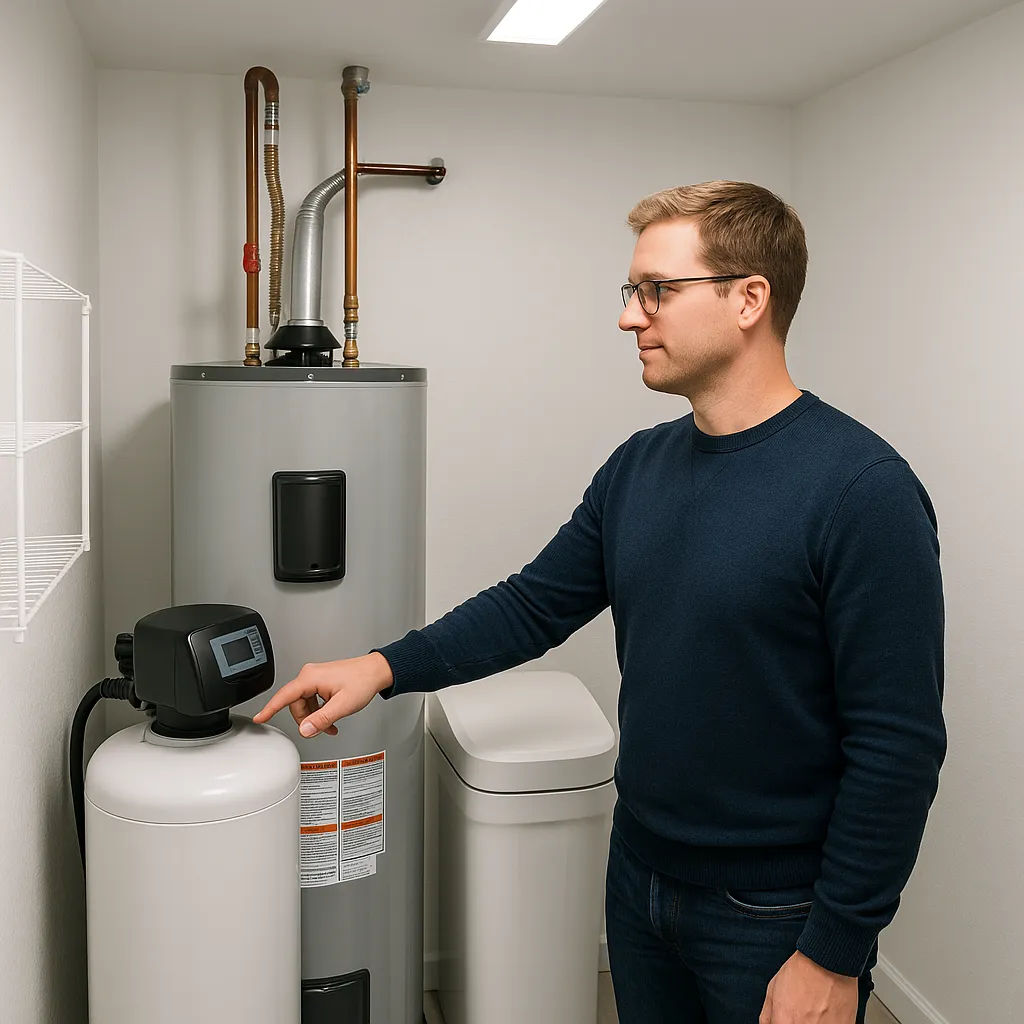
The most important thing you can do when evaluating any home's water heater is find the manufacture date. It's encoded on the serial number label — typically on the upper portion of the tank. The format varies by manufacturer, but generally the first four characters encode the month and year of manufacture. Photograph it and look up the manufacturer's date code format if needed. This single piece of information tells you more about the water heater's remaining useful life than anything else.
Tank Water Heaters: The Minnesota Standard
The traditional storage tank water heater remains the most common type in Minnesota homes. Typical lifespan in Minnesota: 8-12 years — hard water without softening regularly pushes this toward the lower end.
| Household Size | Recommended Tank Size |
|---|---|
| 1-2 people | 30-40 gallons |
| 3-4 people | 40-50 gallons |
| 5+ people | 50-80 gallons |
Signs a Tank Water Heater Is Failing
- Rust-colored or metallic-tasting hot water (interior corrosion)
- Rumbling, popping, or banging sounds during heating (mineral scale on the heating element)
- Inconsistent water temperature — fluctuating between hot and cold
- Visible rust, corrosion, or moisture staining on the exterior of the tank
- Water pooling at the base — even a small leak means the tank is compromised
- Age over 10 years in a hard-water area without a softener
The Anode Rod: The Unsung Hero of Water Heater Longevity
Inside every tank water heater is a sacrificial anode rod — a magnesium or aluminum rod that corrodes in place of the tank itself, dramatically extending its life. An anode rod should be inspected every 3-5 years and replaced when depleted. If a home's water heater is 8+ years old with no record of anode rod replacement, assume it needs attention. A new anode rod costs $30-$80 plus labor. A new tank costs $900-$2,500.
The T&P Relief Valve
Every tank water heater has a temperature and pressure (T&P) relief valve — a critical safety device that releases pressure if the tank overheats. Ensure the T&P valve has a proper discharge pipe directed downward and toward a drain. A T&P valve without a discharge pipe — or one that's been capped — is a safety hazard and a code violation.
Tankless (On-Demand) Water Heaters: Growing in Popularity
Tankless water heaters heat water instantly as it flows through the unit, eliminating standby heat loss. They're becoming increasingly common in Minnesota new construction and renovations.
- Longer lifespan: 15-25 years vs. 8-12 for tank units
- Energy efficiency: No standby heat loss — you only heat what you use. Our guide on energy efficiency in your Minnesota home explains how this reduces utility bills.
- Unlimited hot water: No tank to deplete — ideal for large households
- Space savings: Wall-mounted, freeing up floor space in utility rooms and basements
The Minnesota caveat: Tankless units require periodic descaling — typically every 1-2 years in hard water areas — to dissolve mineral buildup in the heat exchanger. When buying a home with a tankless water heater, always ask for the maintenance history. Installation cost: $2,500-$5,000+
Heat Pump Water Heaters: Efficient but Situational in Minnesota
Heat pump water heaters extract heat from the surrounding air to heat water, using significantly less electricity than conventional electric resistance elements. The Minnesota consideration: these units work best when ambient air temperature is above 40-50°F. In a cold, uninsulated Minnesota basement or utility room during winter, the heat pump mode becomes less efficient and the unit reverts to conventional resistance heating. They work well in conditioned spaces but are less ideal in unheated utility areas.
Water Softeners: The Minnesota Homeowner's Best Friend
How a Water Softener Works
Standard salt-based water softeners use a process called ion exchange: hard water flows through a resin tank filled with sodium-charged resin beads. The beads capture calcium and magnesium ions, releasing sodium ions in their place. Periodically, the system runs a regeneration cycle, flushing the resin tank with a salt brine solution that recharges the beads. This requires adding salt to the brine tank regularly — typically a 40-lb bag every 6-8 weeks.
Salt-Based vs. Salt-Free Systems
| System Type | How It Works | Effectiveness | Best For |
|---|---|---|---|
| Salt-Based Softener | Ion exchange — removes hardness minerals | Highly effective — true softening | Most MN homes with hard water |
| Salt-Free Conditioner | Alters mineral structure | Prevents scale but doesn't remove hardness | Lower maintenance preference |
| Reverse Osmosis | Membrane filtration | Excellent for drinking water | Combined with softener |
| Iron Filter | Oxidation/filtration | Removes iron from well water | Rural MN well water |
Evaluating a Water Softener When Buying a Home
- Age and lifespan: A quality water softener lasts 10-15 years. Ask for the installation date. A unit over 10 years old may be nearing end of reliable service — factor replacement cost ($800-$3,000 installed) into your evaluation.
- Size and capacity: Softeners are sized by grain capacity. A unit significantly undersized for the household's water use will regenerate constantly, wasting salt and water.
- Salt level and resin condition: Check the brine tank salt level. A tank that's nearly empty may indicate the system hasn't been maintained. Resin beads can become fouled with iron or organic material over time.
- Bypass valve: Every softener should have a bypass valve allowing water to flow around the system for maintenance. Verify this is present and functional.
The Financial Case for a Water Softener in Minnesota
The ROI on a water softener in a hard-water Minnesota market is well documented: water heaters in soft-water homes can last up to 50% longer, appliances use less energy and require fewer repairs, and softened water requires significantly less soap and detergent. A well-maintained water softener doesn't just improve your quality of life — it actively protects the investment you're making in the home's systems. Our guide on plumbing in Minnesota homes emphasizes evaluating the entire water management system as a unit: the softener, the water heater, the pipes, and the fixtures all function as one interconnected system.
Well Water Considerations in Minnesota
If the home you're buying is on a private well rather than municipal water, the water quality conversation expands significantly. Well water in rural and some suburban Minnesota areas can present challenges beyond hardness:
- Iron: Many Minnesota wells — particularly in Wright County, Sherburne County, and areas with iron-rich geology — have elevated iron levels causing orange/brown staining on fixtures and laundry. An iron filter may be needed.
- Bacteria: Wells should be tested for coliform bacteria and E. coli at purchase. A positive bacteria test requires immediate remediation before the home is safe for occupancy.
- Nitrates: Common near agricultural areas of Minnesota, elevated nitrates are particularly dangerous for infants. Testing is essential.
- Hardness levels: Well water in many Minnesota areas is even harder than municipal water. A properly sized and maintained softener is especially important.
The Minnesota Department of Health recommends testing private well water annually for bacteria and nitrates, and every 2-3 years for other contaminants. When buying a home on well water, request the most recent water test results — and commission your own independent test as part of due diligence.
How These Systems Connect to the Whole Home
Water heaters and softeners don't exist in isolation. Hard water that degrades a water heater also accelerates wear in your furnace and heating system's humidifier and any hydronic heating components. The winter storm damage and frozen pipes we've covered can affect water heater supply lines and softener connections in unprotected utility areas. And always remember: radon testing before you buy is essential regardless of what the water systems look like. A home with perfect water systems and elevated radon is still a home that needs attention before you close.
The whole-home approach — evaluating every system in context — is the only way to truly understand what you're buying.
Frequently Asked Questions: Water Heaters and Softeners in Minnesota
How long does a water heater last in Minnesota?
Standard tank water heaters typically last 8-12 years nationally, but Minnesota's hard water — which deposits mineral scale on heating elements and inside tanks — often pushes the functional lifespan toward the lower end. A tank water heater in a hard-water area without a functioning water softener may show significant wear by year 8. Tankless water heaters last 15-25 years but require periodic descaling in hard water areas. Always check the manufacture date on the label before closing.
What type of water heater is best for a Minnesota home?
For most Minnesota buyers, the choice comes down to a quality tank water heater (most affordable, standard installation) vs. a tankless system (higher upfront cost, longer lifespan, greater energy efficiency, no standby heat loss). Tankless units are an excellent long-term investment but require descaling maintenance in hard water areas. Heat pump water heaters work well in conditioned spaces but are less efficient in cold uninsulated utility rooms during Minnesota winters. The best choice depends on household size, utility costs, and the home's specific configuration.
Does Minnesota have hard water and how does it affect my home?
Yes — significantly. Most of Minnesota, including the Twin Cities Metro, Wright County communities like Otsego, and much of central and southern Minnesota, has hard to very hard water with hardness levels of 15-30+ GPG. Hard water causes mineral scale buildup inside water heaters, pipes, and appliances — reducing efficiency, shortening lifespan, and increasing operating costs. It also affects soap performance, leaves deposits on fixtures and glass, and gradually restricts water flow in older piping systems. A properly functioning water softener is one of the most protective investments a Minnesota homeowner can make.
Do I need a water softener in Minnesota?
In most Minnesota communities with hard water — which is most of the state — a salt-based water softener is highly recommended. Without one, mineral scale accumulates in your water heater (reducing efficiency by up to 30% with just 1/8 inch of buildup), shortens appliance lifespan, and degrades fixtures over time. When buying a home, check whether a softener is present, verify its age and condition, and factor replacement cost ($800-$3,000 installed) into your evaluation if the unit is aging.
How much does a water heater replacement cost in Minnesota?
A standard tank water heater replacement in Minnesota typically runs $900-$2,500 including labor and installation. Tankless water heater installation costs significantly more — $2,500-$5,000+ — due to the additional venting, gas line, or electrical work often required. Heat pump water heaters typically run $1,500-$3,500 installed. These costs make the water heater's age and condition a meaningful factor in purchase negotiations — a 10+ year old water heater in a hard-water area is a legitimate item to address in your offer.
What should I check on a water heater when buying a home in Minnesota?
Check the manufacture date on the serial number label (first priority), look for rust or corrosion on the exterior, listen for rumbling or popping during operation (mineral scale on the element), check the T&P relief valve for a proper discharge pipe, verify the tank size is appropriate for the home's household size, and check whether a water softener has been protecting the unit. For tankless units, ask for the descaling maintenance history. Any water heater over 10 years old in a hard-water area without documented softener protection deserves professional evaluation.
How does a water softener affect home value in Minnesota?
A functioning, properly maintained water softener is a positive feature that most informed Minnesota buyers look for — particularly in hard-water areas. It signals that the homeowner has been actively protecting the plumbing, water heater, and appliances, which translates to lower maintenance costs for the buyer going forward. While a water softener alone doesn't dramatically move a home's appraised value, its absence in a known hard-water market is a factor buyers increasingly notice — and occasionally negotiate. For questions about how home improvements affect your tax basis, always consult a qualified tax professional.
Ready to Buy Smart in Minnesota?
The water systems in any Minnesota home you're considering are quietly telling a story — about how the home has been maintained, what it's going to cost you going forward, and how well it's been protected against our uniquely demanding water chemistry.
At Circle Partners — KW Real Estate Planners, we help Minnesota buyers read that story before they sign. Because understanding what you're buying — all of it, including the systems you can't see — is what separates a great real estate decision from an expensive lesson.
Call us: 763-340-2002
Email us: [email protected]
Visit us: 16201 90th St NE, Suite #100, Otsego, MN 55330
Circle Partners is a licensed real estate team with KW Real Estate Planners, serving buyers and investors across Minnesota. This post is for informational purposes only and does not constitute legal, tax, or financial advice. For guidance specific to your situation, always consult a qualified attorney, CPA, licensed plumber, or other qualified professional.