
The Minnesota Homeowner's Complete Guide to Central Air Conditioning: How It Works, How Long It Lasts & Your Best Alternatives
Minnesota has two seasons that really test your cooling system: the brief, brutal stretch of July and August humidity that feels nothing like the brochure, and the first hot weekend of June when you finally flip on the AC for the first time and hope for the best.
If you're buying a home in Minnesota, the cooling system deserves more attention than most buyers give it. It's easy to focus on the furnace in February — but the AC is equally important, equally expensive to replace, and far less well understood by most homeowners.
At Circle Partners, we work as Real Estate Planners. That means when we walk a home with a buyer, we look at the cooling system the way a contractor looks at it — age, condition, efficiency, refrigerant type, duct integrity, and what it's actually going to cost to run or replace. Here's what you need to know.
How Does a Central Air Conditioner Actually Work?
A central air conditioner doesn't "create" cold air the way a furnace creates heat. It moves heat — specifically, it pulls heat out of your indoor air and transfers it outside. The result is cooler, drier air circulating through your home.
The four major components:
1. The Evaporator Coil (Inside)
Located inside or adjacent to the air handler/furnace, the evaporator coil contains refrigerant — a chemical compound that absorbs heat very efficiently. When warm air from your home is pulled across the cold evaporator coil, the refrigerant absorbs the heat. The air is cooled and returned to your living spaces through the duct system. The refrigerant, now warm, moves to the next stage.
2. The Compressor (Outside)
The compressor — housed in the outdoor condenser unit — pressurizes the warm refrigerant, converting it from a low-pressure gas to a high-pressure, high-temperature gas. This is the heart of the system and the component whose failure is usually the end of an older unit's life.
3. The Condenser Coil (Outside)
The hot, pressurized refrigerant passes through the condenser coil, where a fan blows outdoor air across it. The refrigerant releases its heat to the outdoor air and cools down, converting back to a liquid.
4. The Expansion Valve
The liquid refrigerant passes through an expansion valve, which reduces its pressure and temperature dramatically — returning it to a cold, low-pressure state ready to absorb heat again at the evaporator coil. The cycle repeats continuously.
The dehumidification bonus: As a byproduct of this heat transfer process, the evaporator coil also condenses moisture out of the air — which is why a properly running air conditioner also controls indoor humidity. A Minnesota home with a well-functioning AC is both cooler and drier.
What connects it all — the duct system:
Central AC uses the same duct system as your furnace to distribute conditioned air throughout the home. This is an advantage (no separate infrastructure needed) but also a potential weakness — leaky, poorly insulated, or undersized ducts significantly reduce efficiency and comfort. An attic that isn't properly insulated makes this worse — heat radiating down from a poorly insulated attic is working directly against your air conditioner.
SEER Ratings: How to Read Efficiency
Every air conditioner has a SEER rating — Seasonal Energy Efficiency Ratio. The higher the number, the less electricity the unit uses to produce the same amount of cooling.
SEER RatingEfficiency LevelNotes10–12Low (pre-2006 standard)Common in older homes; significantly higher operating costs13–14Minimum (current federal minimum)Adequate but not optimal15–17GoodSolid efficiency for Minnesota18–20HighMeaningful energy savings, higher upfront cost21+PremiumInverter-drive technology; best efficiency available
What this means for buyers: A home with a SEER 10 system that's 15 years old isn't just due for replacement because of age — a modern SEER 16 unit uses roughly 40% less electricity to produce the same cooling output. Over a typical Minnesota summer, that difference is significant. We cover the full range of strategies for lowering your air conditioning bills in Minnesota — efficiency starts with the equipment but doesn't end there.
How Long Does a Central Air Conditioner Last in Minnesota?
The honest answer: 10 to 15 years is the realistic range for most central AC systems in Minnesota, with well-maintained units occasionally reaching 18–20 years.
Minnesota is harder on AC systems than the national average suggests — not because we run our AC constantly, but because of the extreme temperature swings our equipment endures. An outdoor condenser unit that sits through -30°F winters and then gets called to run on 90°F summer days experiences significant thermal cycling on every component year after year.
What affects lifespan most:
FactorImpactAnnual maintenanceThe #1 factor — serviced units consistently outlast neglected onesProper sizingAn oversized unit that short-cycles wears components fasterRefrigerant leaksA unit running low on refrigerant works harder and fails soonerCottonwood seasonMinnesota's annual cottonwood buildup clogs condenser coils — a uniquely local challengeElectrical qualityPower fluctuations and hard starts stress compressorsOriginal installation qualityProperly sized and correctly charged units consistently outlast those that weren't
The 5,000-rule for repair vs. replace:
Multiply the age of the unit by the cost of the repair. If the result exceeds $5,000, replacement is typically the better investment. A 12-year-old unit with a $500 repair estimate: 12 × $500 = $6,000 — favors replacement. A 6-year-old unit with the same repair: 6 × $500 = $3,000 — favors repair.
Signs Your AC System Is Failing
Know what to watch for — especially when evaluating a home to purchase:
Warm air from vents when the system is running — could indicate refrigerant loss, a failing compressor, or duct issues
Weak airflow — dirty evaporator coil, duct blockage, or a failing air handler motor
Short cycling — the unit turns on, runs briefly, and shuts off repeatedly. Usually indicates an oversized unit or incorrect refrigerant charge.
Unusual noises — grinding or screeching indicates failing bearings; banging or rattling suggests loose components
Ice on the refrigerant lines or evaporator coil — indicates restricted airflow or low refrigerant
High indoor humidity while the AC is running — a properly functioning AC dehumidifies; high humidity while running means something is off
Sudden spike in electricity bills — a system working harder than it should to maintain temperature
The system is 12+ years old without regular professional maintenance — treat it as a near-term budget item regardless of current performance
AC Maintenance: What Every Minnesota Homeowner Should Do
Spring Startup (April–May)
Clear all debris from around the condenser unit — leaves, seed pods, and cottonwood from the previous fall
Visually inspect refrigerant lines for damage
Turn the thermostat to cooling mode and confirm the system produces cold air before the first hot day. Important: Do not run the system when outdoor temps are below 60°F — the refrigerant doesn't perform correctly at low temperatures and you can damage the compressor.
Replace the furnace filter — the same filtration system handles both heating and cooling
During Cottonwood Season (Late May–June)
This is a uniquely Minnesota maintenance item. Cottonwood seeds coat the condenser coil fins, blocking airflow and reducing efficiency dramatically. Gently rinse the condenser coil with a garden hose (low pressure, spray from inside out) when cottonwood buildup is heavy. Do this annually — it takes 10 minutes and makes a real difference.
Mid-Season
Replace furnace filters every 1–3 months during the cooling season
Keep vegetation cleared 2 feet from the condenser on all sides
Ensure condensate drain lines are clear — a clogged condensate drain can shut the system off via the safety float switch, or worse, overflow and cause water damage
Annual Professional Service
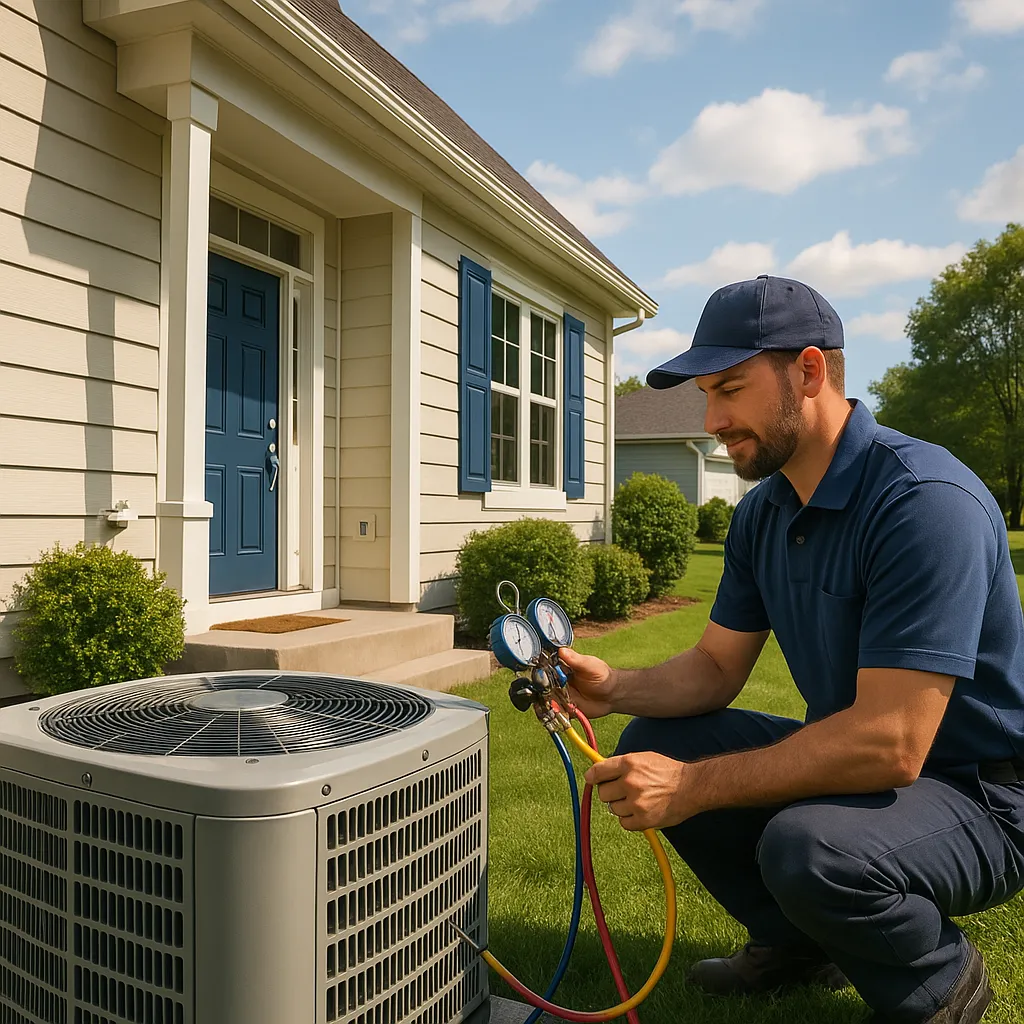
Have a licensed HVAC technician service the system every 1–2 years. A professional tune-up includes: refrigerant level check, electrical component testing, coil cleaning, bearing lubrication, and a full system performance evaluation. Refrigerant handling is federally regulated — this is not a DIY task. This maintenance habit connects directly to the energy efficiency practices that keep your annual operating costs under control.
Alternatives to Central Air Conditioning in Minnesota
Not every Minnesota home has central AC — and not every buyer needs it. Here's an honest breakdown of the alternatives.
Ductless Mini-Split Systems
The most significant alternative to traditional central AC today. A mini-split system consists of an outdoor compressor unit connected to one or more indoor air handlers mounted on the wall or ceiling — no ductwork required.
Advantages for Minnesota buyers:
No duct system required — ideal for older homes, additions, finished basements, and garages
Each zone controlled independently
Most mini-splits also function as heat pumps, providing heating in addition to cooling
Very high efficiency ratings (often SEER 20+)
Quieter operation than window units
No window opening for security or weather infiltration
Cost: A single-zone mini-split typically costs $2,500–$5,000 installed. Multi-zone systems run $8,000–$18,000+ depending on the number of zones.
Best applications: Finished basements, bonus rooms, above-garage bedrooms, older homes without ductwork, and three-season additions.
Cold-Climate Heat Pumps (Air Source)
A heat pump operates on the same refrigeration cycle as an air conditioner — but it can run the cycle in reverse, providing heating in winter as well as cooling in summer. Modern cold-climate heat pumps now perform effectively down to -15°F or below, making them a viable primary heating source in Minnesota.
For buyers, a home equipped with a cold-climate heat pump has a year-round HVAC solution in a single system. The economics depend on local electricity vs. natural gas costs. Understanding how this pairs with the heating system in your Minnesota home is an important part of the evaluation.
Cost: $12,000–$22,000+ for a full system replacement, depending on home size and configuration.
Window Air Conditioners
Self-contained units that cool a single room. Practical for cooling a bedroom that central AC doesn't effectively reach, finished spaces without ductwork, or supplemental cooling during extreme heat events.
Limitations: Cools only one room, reduces security and insulation at the window opening, and is significantly less efficient than central or mini-split systems at comparable output. A solution — not the solution.
Whole-House Fans
Installed in the ceiling between the living space and attic, a whole-house fan pulls cool evening air in through open windows and exhausts warm attic air outside.
What they're good at: Rapidly cooling a home in the evening after a hot day and reducing the hours your AC needs to run by pre-cooling the home overnight.
What they're not: A replacement for air conditioning during hot, humid Minnesota heat waves. When outdoor humidity stays high overnight — which it does during our worst stretches — a whole-house fan pushes humid outdoor air into the home, which is counterproductive.
Best application: As a complement to central AC in a well-insulated home, not a replacement.
What Buyers Should Look For When Evaluating a Cooling System
Age and condition:
Find the data plate on the outdoor condenser — it shows the manufacturing date and original SEER rating
A system over 12–15 years old should be factored into your budget as a near-term replacement
Look for rust, physical damage, and signs of deferred maintenance on the outdoor unit
Refrigerant type — this matters:
Systems manufactured before 2010 likely use R-22 refrigerant (Freon), which has been federally phased out. R-22 is no longer manufactured, making refrigerant extremely expensive — sometimes $100–$150 per pound. A home with an R-22 system and a refrigerant leak is typically facing replacement, not repair.
Systems from 2010 onward use R-410A or R-454B — currently available and far less expensive.
Duct system condition:
Look for visible duct runs in the basement or crawlspace — damaged, disconnected, or uninsulated ducts dramatically reduce cooling effectiveness
Ask whether the home has had additions since the original system was installed — a system sized for the original footprint may be undersized for an expanded home
For a home without central AC:
Evaluate whether existing ductwork could support AC addition
Central AC installation in a home with existing compatible ductwork typically runs $4,000–$8,000
Factor the cost of adding cooling into your offer
All of this is part of the bigger picture of understanding your home's safety and mechanical systems before you close.
🏡 Real Estate Planner Perspective: We see buyers overlook HVAC all the time — they fall in love with the kitchen and don't check the age of the AC. Then they close in March, the first heat wave hits in July, and the 17-year-old system that barely passed the inspection fails on the hottest weekend of the year. We help buyers see the mechanical systems as clearly as they see the finishes. Book a consultation with Circle Partners →
What Does a New Cooling System Cost in Minnesota?
Replacement ScenarioEstimated Cost RangeCentral AC only (existing compatible ductwork)$4,000–$8,000 installedCentral AC + furnace (full HVAC replacement)$8,000–$15,000+ installedSingle-zone ductless mini-split$2,500–$5,000 installedMulti-zone mini-split system (3–4 zones)$8,000–$18,000+ installedCold-climate heat pump (full system)$12,000–$22,000+ installed
Get three quotes from licensed HVAC contractors for any major replacement. Pricing varies significantly by home size, equipment brand, and installation complexity.
Frequently Asked Questions: Central AC in Minnesota
How does a central air conditioner work?
A central air conditioner works by moving heat out of your home rather than generating cold air. It uses a refrigerant to pull heat from your indoor air at the evaporator coil inside, compress and release that heat through the condenser unit outside, and return cool, dry air to your living spaces through the duct system. As a byproduct, the process removes moisture from the air — which is why a properly functioning AC also helps control indoor humidity. The outdoor condenser, the indoor air handler, the ductwork, and the thermostat all work together as one integrated system.
How long does a central air conditioner last in Minnesota?
Most central AC systems in Minnesota last 10 to 15 years with normal use and basic maintenance. Well-maintained units can reach 18–20 years; neglected systems may fail in 8–10 years. Minnesota is particularly demanding on AC equipment — outdoor units endure extreme winter cold followed by heavy summer use, accelerating wear on compressors, fan motors, and electrical components. Annual professional maintenance is the single most effective way to maximize lifespan. When evaluating a home purchase, any system over 12–15 years old should be factored into your budget as a near-term replacement.
What is a good SEER rating for a Minnesota home?
For most Minnesota homes, SEER 15–17 represents a solid balance of upfront cost and energy savings. The federal minimum for new equipment is SEER 13–14. Systems rated SEER 18 and above use inverter-driven compressor technology that further reduces energy consumption and provides better humidity control, but come at a higher upfront cost. For a home you plan to own long-term, higher efficiency typically justifies the investment. An HVAC contractor can provide a payback analysis based on your specific energy costs and usage patterns.
What are the best alternatives to central air conditioning in a Minnesota home?
The most practical alternatives are: (1) Ductless mini-split systems — highly efficient, zoned, and ideal for homes without ductwork or for additions and finished basements; (2) Cold-climate heat pumps — provide both heating and cooling from a single system, now viable in Minnesota winters; (3) Whole-house fans — effective for overnight cooling in mild weather, best as a complement to AC rather than a replacement; and (4) Window air conditioners — practical for individual rooms without ductwork. For most buyers, central AC with a properly maintained duct system remains the most practical whole-home comfort solution, but mini-splits are rapidly gaining ground as a viable alternative.
What is a ductless mini-split and is it right for my Minnesota home?
A ductless mini-split is a cooling (and usually heating) system consisting of an outdoor compressor unit connected directly to one or more indoor air handlers via refrigerant lines — no ductwork required. Each indoor head conditions one zone independently. Mini-splits are excellent for homes without existing ductwork, finished basements, bonus rooms, older homes where adding ductwork is cost-prohibitive, and any space needing independent temperature control. Most also function as heat pumps, providing supplemental or primary heating. They're more expensive than window units but dramatically more efficient and effective.
When should I replace my AC instead of repairing it?
A useful guideline: multiply the unit's age by the repair cost. If the result exceeds $5,000, replacement is generally the better investment. Additional factors that favor replacement: the system uses R-22 refrigerant (phased out, now extremely expensive); the compressor has failed; the system is improperly sized; or the SEER rating is below 13. When buying a home, any system over 12–15 years old should be evaluated by a licensed HVAC technician as part of your due diligence — the standard inspection report alone may not tell you enough about remaining useful life.
How do I know if my home's AC is properly sized?
An improperly sized AC — whether too large or too small — causes real problems. An oversized unit cools quickly but doesn't run long enough to remove humidity, leaving rooms feeling cool but clammy, and it short-cycles, accelerating compressor wear. An undersized unit runs continuously without reaching the set temperature on hot days. Proper sizing is based on a Manual J load calculation — a systematic evaluation of the home's size, insulation, windows, and climate. If the home has had significant additions or renovations since the system was installed, proper sizing should be verified by a licensed HVAC professional before you close.
Your Comfort System Is Worth Understanding
You don't have to become an HVAC technician to be a smart homeowner — but you do have to know what you're buying. A 16-year-old air conditioner running on refrigerant that's no longer manufactured, in a home with leaky ducts and an under-insulated attic, is a very different purchase than a 4-year-old high-efficiency system that's been professionally serviced every year.
At Circle Partners — KW Real Estate Planners, we help Minnesota buyers see the difference before they sign anything. Because buying a home is about the whole picture — not just the rooms you fall in love with, but the systems that keep those rooms livable year after year.
📞 Call us: 763-340-2002
📧 Email us: [email protected]
📍 Visit us: 16201 90th St NE, Suite #100, Otsego, MN 55330
📅 Book Your Free Real Estate Planning Consultation
Circle Partners is a licensed real estate team with KW Real Estate Planners, serving buyers and investors across Minnesota. This post is for informational purposes only and does not constitute legal, tax, or financial advice. For guidance specific to your situation, always consult a qualified attorney, CPA, or other qualified expert.