
Keep Water Where It Belongs: The Minnesota Homeowner's Complete Guide to Controlling Exterior Water
Water damage is the single most common — and most expensive — source of structural problems in Minnesota homes. Not fire. Not wind. Water. And the frustrating part is that most water damage doesn't come from catastrophic events. It comes from years of poorly managed exterior drainage: a downspout that dumps water against the foundation, a yard that slopes toward the house instead of away from it, a patio that channels runoff toward the back door, a window well that fills up every spring because no one ever put a drain in it.
These aren't glamorous problems. They're slow, silent, and cumulative — until the day they're not.
At Circle Partners, we work as Real Estate Planners. One of the most consistent patterns we see when evaluating homes with buyers is this: the homes with the most expensive hidden problems almost always have exterior water management issues that were either ignored or never properly addressed. Wet basements, foundation cracks, compromised crawlspaces, deteriorated sill plates — these problems almost always trace back to water that was going somewhere it shouldn't.
This guide is about understanding where water goes on your property, how to control it, and how to make sure it's working for you — not against you.
Why Water Is Minnesota's Biggest Home Threat
Minnesota's climate creates an unusual combination of water challenges:
Heavy spring snowmelt — in a typical Minnesota spring, several feet of accumulated snow melt in a matter of weeks. That's an enormous volume of water saturating the soil around every foundation in the state simultaneously.
Clay-heavy soils across much of the metro and southern Minnesota shed water rather than absorbing it — meaning runoff moves fast and accumulates quickly.
Freeze-thaw cycles — water that penetrates cracks in concrete and masonry expands when it freezes, progressively widening those cracks season after season.
Summer storm intensity — Minnesota regularly sees heavy rainfall events that drop 2–4 inches in a matter of hours, overwhelming yard drainage and downspout systems that might handle normal rain just fine.
Ice dams in winter create pooling water at the roofline that can force its way under shingles and into wall cavities — a roofline water problem that becomes an interior water problem.
The result: Minnesota homeowners deal with more sustained exterior water pressure than almost anywhere in the country. And the difference between a home that handles it well and one that doesn't often comes down to a few specific decisions that were — or weren't — made.
The Foundation of Everything: Grading
If there's one exterior water concept that matters more than any other, it's grading — the slope of the ground around your home's foundation.
The rule is simple: the ground should slope away from your home at a minimum of 6 inches over the first 10 feet. This slope ensures that water — from rain, from snowmelt, from downspouts — moves away from the foundation and doesn't pool against the wall.
When grading fails — when soil settles over time and creates a flat or inward-sloping surface next to the foundation — water stops moving. It sits against the foundation wall. It saturates the soil around the footing. It finds cracks and pores in the concrete or block. And eventually, it finds its way inside.
How to assess your grading:
Walk the perimeter of your home after a significant rainfall. Are there areas where water pools against the foundation for more than a few minutes?
Look for areas where the soil has settled and created low spots adjacent to the foundation walls
Check along the back of the home, under decks, and around additions — these are the areas where grading problems are most commonly overlooked
How to fix poor grading:
In most cases, re-grading is a straightforward fix — add topsoil to create the proper slope away from the foundation. Use clean fill dirt and grade the surface at the correct slope before seeding or installing landscaping. For significant grade corrections — especially around the foundation of a home with a history of wet basement issues — a grading contractor or landscape professional is worth the investment. This connects directly to understanding basements, crawlspaces & foundation types and how water reaches them.
Gutters and Downspouts: Your First Line of Defense
The gutter system exists for one purpose: to collect water from the roof and move it away from the foundation. When it works well, it's invisible. When it fails — or when it's undersized, clogged, or missing — the consequences are significant.
A 2,000 sq ft roof sheds roughly 1,250 gallons of water per inch of rainfall. All of that water needs somewhere to go. Without gutters, it falls directly off the eaves, saturating the soil at the foundation perimeter and creating exactly the conditions that lead to basement moisture, foundation erosion, and siding damage.
The full picture of gutter system requirements, sizing, maintenance, and Minnesota-specific considerations is covered in our gutters and downspout system guide — but here are the water management essentials:
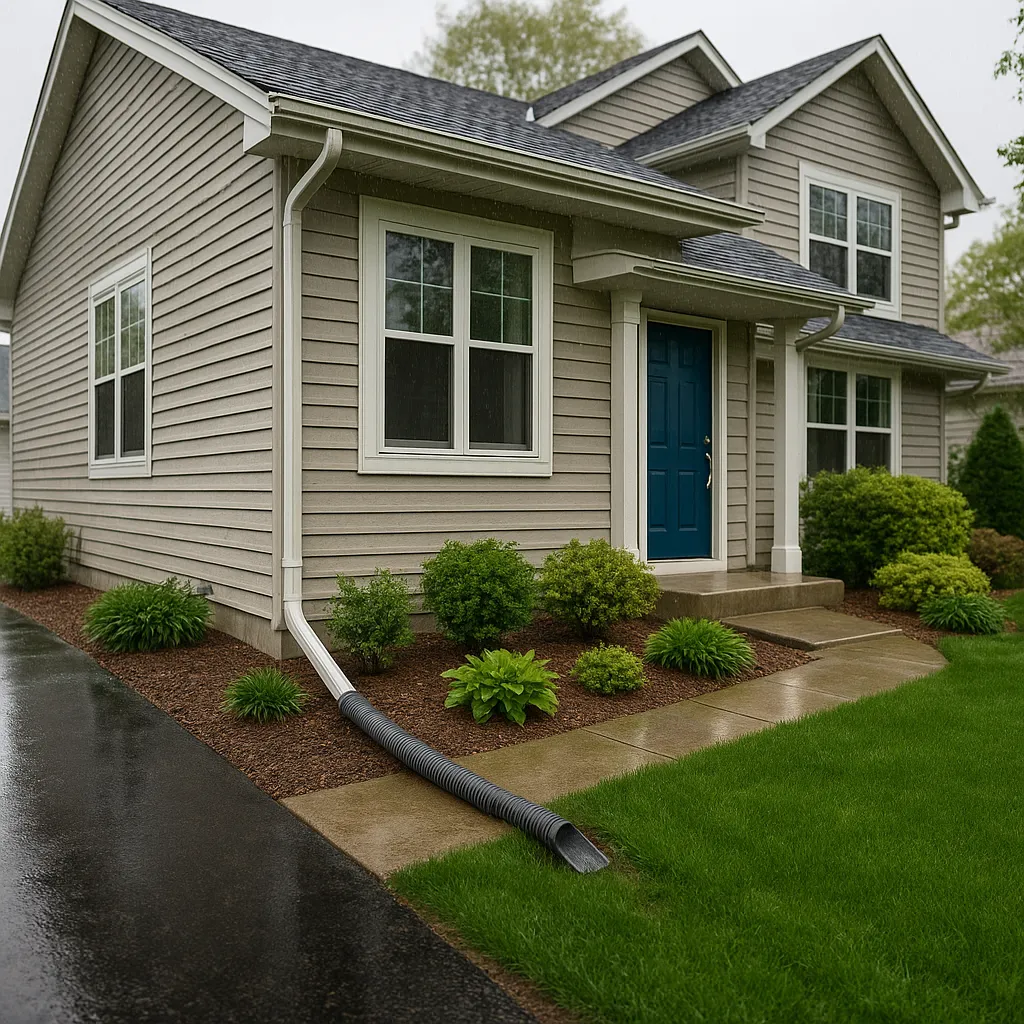
Downspout extensions: This is where most homes fall short. A downspout that terminates at the foundation does almost nothing — the water just dumps against the house 6 inches from the wall. Every downspout should discharge water at least 6 feet from the foundation, and ideally 10 feet or more. Splash blocks are a minimum; a downspout extension that directs flow to the yard or a drainage swale is significantly better.
Buried downspout drains: Many Minnesota homes have downspouts connected to underground drain lines that carry water away from the house entirely. These are excellent solutions, but they require periodic inspection and cleaning. A buried drain line that has crushed, shifted, or silted up is no better — and potentially worse — than no drain at all.
Gutter maintenance: Gutters that are full of leaves and debris in October overflow during November rain and snowmelt — dumping water directly against the foundation. Clean gutters are a non-negotiable item in fall maintenance. Include them in your annual winter storm damage inspection checklist.
Window Wells: The Overlooked Water Risk
Basement windows on the exterior of the home typically sit below or at grade level — which means they're surrounded by a curved metal or plastic wall (the window well) that's supposed to keep soil and water away from the window.
Window wells are a significant water management vulnerability that many homeowners don't think about until they're bailing water out of one after a heavy rain.
Common window well problems in Minnesota:
No drain — a window well with no drainage at the bottom simply collects water until it overflows the well, saturates the window frame, and eventually leaks into the basement. Every window well should have a gravel base that drains to either the foundation drain system or to daylight.
Debris accumulation — leaves, dirt, and debris block the drain and turn the well into a catch basin. Clean them out every spring and fall.
Well too small or too shallow — a well that barely extends above grade traps water and snowmelt in spring. The top of the well should sit at least 4 inches above the surrounding grade.
Window seal failure — old or poorly maintained window frames let water in even when the well itself is functioning. Inspect the caulk and flashing around each window annually.
Window well covers: A clear polycarbonate cover that keeps rain and debris out of the well is an inexpensive, practical solution for any window well without a reliable drainage system.
Yard Drainage: Moving Water Across Your Property
Controlling water at the foundation is essential — but water management on the broader property matters too. A yard that holds water, drains toward the home, or channels runoff toward the foundation undoes all the good work proper grading does.
Drainage Swales
A swale is a shallow, linear depression in the yard that guides water in a specific direction — away from the home, toward a street, or to a low point on the property that drains well. Many neighborhoods have swales built into the grading between properties — these are intentional, and filling them in or landscaping over them creates problems for the entire neighborhood.
If your yard lacks adequate drainage channels, a landscape contractor can cut or shape swales to direct water appropriately. This is particularly important for landscaping decisions around your home — good landscaping works with the drainage, not against it.
French Drains
A French drain is a perforated pipe buried in a gravel-filled trench that collects groundwater and surface water and redirects it away from a problem area. French drains are used to:
Intercept surface water before it reaches the foundation
Relieve hydrostatic pressure on the foundation wall from saturated soil
Drain chronically wet areas of the yard
Protect the base of retaining walls and sloped areas from erosion
French drains need to be properly sized, installed with appropriate filter fabric to prevent silt infiltration, and directed to a suitable discharge point. Consult a landscape contractor or civil engineer for design on complex drainage situations.
Catch Basins
A catch basin is a surface drain — essentially a grate set into a low point in a patio, driveway, or yard — that collects surface water and directs it underground to a drain line. They're commonly used in areas where grading can't be corrected to allow surface drainage, or where water consistently pools in a specific spot.
Driveways and Hard Surfaces: Where Water Has Nowhere to Go
Impervious surfaces — concrete driveways, asphalt, patios, and sidewalks — don't absorb water. They shed it, and the direction it goes matters.
A driveway that slopes toward the garage or the house channels every rain event and every snowmelt event directly at the foundation. Understanding driveway materials and drainage is part of the full picture — but from a water management standpoint, the key questions are:
Does the driveway drain toward the street or toward the house?
Are there cracks where water infiltrates and accelerates freeze-thaw damage?
Does the garage apron slope away from the garage door threshold?
Does the patio or deck area drain away from the home or toward it?
Permeable paving options — interlocking permeable pavers, permeable asphalt, or pea gravel — allow water to infiltrate rather than run off. These are increasingly popular for driveways, patios, and walkways in areas where managing runoff volume is a priority.
Sump Pumps: The Last Line of Defense
When all the exterior measures above are working correctly, very little water should ever reach the interior drainage system around the foundation. But in Minnesota — with our clay soils, our snowmelt volumes, and our storm intensity — even well-designed exterior systems can be overwhelmed during major events.
The sump pump is the last line of defense: a pump in a pit at the lowest point of the basement that collects water from the foundation drain system and pumps it out and away from the home.
What every Minnesota homeowner needs to know about sump pumps:
Test it annually — pour a bucket of water into the pit to verify the pump activates. Do this before spring snowmelt season.
Battery backup — a primary sump pump that runs on house power is useless during a power outage — which is exactly when the worst storms hit. A battery backup pump is essential in any Minnesota home where basement moisture is a concern.
Discharge location — verify the discharge line terminates at least 10 feet from the foundation and drains to daylight or a drainage swale — not toward a neighbor's property.
Pit condition — inspect the pit for debris, check that the float moves freely, and verify the check valve is functioning.
Everything about how water reaches the foundation — and what happens when it does — is covered in depth in our guide to basements, crawlspaces & foundation types.
What Buyers Should Look For: Exterior Water Red Flags
When we walk a property with a buyer, exterior water management is one of the first things we evaluate. Here's what raises questions:
High concern:
Evidence of past or current water intrusion in the basement — staining, white mineral deposits (efflorescence) on foundation walls, rust stains at the base of walls, musty odor
Foundation grading that slopes toward the home
Downspouts that terminate at the foundation
Window wells with no drain, full of debris, or below grade
Active settling cracks in the foundation with evidence of water infiltration
A sump pump pit that's dry and dusty in a wet spring — indicates the pump may not be receiving water or was recently replaced after a failure
Worth noting:
Mature landscaping planted directly against the foundation
Flat or minimally sloped patio or driveway surfaces adjacent to the home
Missing or damaged gutter sections
Evidence of ice dam water infiltration around windows or at wall-ceiling junctions on upper floors
None of these observations are automatic dealbreakers — but they're conversations. Our job is to help you understand what you're looking at and what it might cost to address it. Summer storms and water events reveal all of these vulnerabilities fast — which is why post-storm evaluation is one of the most valuable habits any Minnesota homeowner can build.
🏡 Real Estate Planner Perspective: Water issues are the most common source of buyer shock after closing — not because they were hidden, but because buyers didn't know what they were looking at. A grading problem that costs $800 to fix looks the same to an untrained eye as one that requires $25,000 in excavation and foundation waterproofing. We help you know the difference before you sign. Book a consultation with Circle Partners →
The Minnesota Exterior Water Management Calendar
SeasonPriority TasksSpring (March–May)Clear snow from foundation perimeter; check sump pump operation; inspect downspout extensions after snowmelt; look for new settling or grading issues; clean window wellsEarly Summer (June)Inspect and clean gutters after spring debris; check all downspout discharge points; assess yard drainage after first heavy rains; seed or fill any low spots near foundationSummer (July–Aug)Monitor drainage after heavy storm events; check for erosion at downspout discharge points; inspect window well coversFall (Sept–Oct)Clean gutters before freeze; inspect and repair weatherstripping and window well seals; test sump pump and battery backup; grade any settled areas before ground freezesWinter (Nov–Feb)Keep snow shoveled away from foundation; avoid directing snowblower discharge toward foundation; check for ice dam formation at roofline; note ice buildup near foundation for spring follow-up
When to Call a Professional
DIY solutions handle many exterior water issues effectively. But some situations require professional expertise:
Call a professional when:
You have active water intrusion in a basement or crawlspace
Foundation cracks show evidence of water infiltration — especially horizontal cracks in block foundations, which can indicate lateral pressure
Your yard has significant drainage issues that simple grading won't resolve
You need a French drain, catch basin, or underground drain system designed and installed
Your sump pump runs continuously during wet periods — indicates high groundwater that may require professional assessment
You're buying a home and want an independent evaluation of the drainage and water management systems before closing
Frequently Asked Questions: Controlling Exterior Water in Minnesota
How do I stop water from getting into my basement in Minnesota?
Basement water intrusion in Minnesota almost always has one or more exterior causes: poor grading that directs water toward the foundation, gutters and downspouts that discharge too close to the house, window wells without proper drainage, or saturated soil during heavy snowmelt or rain events. Start with the exterior basics — correct the grading, extend your downspouts at least 6 feet from the foundation, clean and repair your gutters, and inspect your window wells. If water intrusion persists after addressing exterior drainage, the next step is evaluating the foundation drain system and sump pump. Interior waterproofing solutions should be considered only after exterior options are exhausted.
What is proper grading around a home's foundation in Minnesota?
The standard recommendation is a minimum slope of 6 inches over the first 10 feet away from the foundation — measured from the base of the foundation wall. This ensures water flows away from the structure rather than pooling against it. In Minnesota, where spring snowmelt saturates the soil around the foundation perimeter all at once, proper grading is especially critical. Soil settlement is common over time, particularly in newer construction where disturbed fill soil continues to compact for years after building. Re-grading with clean fill soil is typically a straightforward fix for mild cases.
How far should downspouts extend from the house?
Downspouts should discharge water a minimum of 6 feet from the foundation — 10 feet is better, and more is never worse. A downspout extension is one of the least expensive and most effective improvements any homeowner can make. For maximum effectiveness, direct downspout discharge toward a sloped area of the yard, a drainage swale, or a buried drain line that carries water to daylight away from the property.
What causes a wet basement in a Minnesota home?
The most common causes of basement moisture in Minnesota homes are, in order of frequency: inadequate exterior grading, improperly managed gutters and downspouts, window wells without drainage, surface water infiltration through foundation cracks, and high groundwater during spring snowmelt or prolonged wet periods. Less common but serious causes include failed interior foundation drain tile systems and hydrostatic pressure from a high water table. The source of the water needs to be identified before any repair strategy is chosen — treating symptoms without addressing the cause leads to recurring problems.
Do I need a French drain in my Minnesota yard?
Not every Minnesota property needs a French drain — but properties with chronic wet spots, areas where water pools after rain or snowmelt, or locations where water consistently flows toward the foundation are strong candidates. A French drain intercepts water before it reaches a problem area and redirects it to a discharge point away from the home. The right solution depends on your specific drainage pattern, soil type, and the volume of water you're managing. A landscape contractor or civil engineer can evaluate your property and recommend whether a French drain is appropriate and how it should be designed.
How do I manage water runoff from my driveway in Minnesota?
Driveways should slope toward the street — away from the garage and the home — so that rain and snowmelt flow toward the road rather than pooling at the foundation. If your driveway has shifted or heaved from freeze-thaw cycling and no longer drains properly, options include mudjacking (lifting settled concrete sections), driveway resurfacing with proper re-grading, or in severe cases, full replacement. A trench drain or catch basin installed at the base of the driveway can intercept water and route it underground to a discharge point away from the home.
What are the signs of exterior water damage when buying a home in Minnesota?
The most telling signs include: white mineral deposits (efflorescence) or rust stains on foundation walls inside the basement, musty odors in the basement or crawlspace, visible cracks in the foundation with staining around them, soil graded toward the home rather than away from it, downspouts that terminate at the foundation, window wells full of debris or without drains, and a sump pump that shows heavy use or recent replacement. On the exterior, look for erosion at the base of the foundation, heaved or settled concrete near the home, and areas of the yard that appear chronically wet. These are the details we help buyers evaluate before making one of the largest financial decisions of their lives.
Water Follows the Path of Least Resistance — Make Sure That Path Is Away From Your Home
Every heavy rain, every spring thaw, every summer storm is a test of how well your home's exterior water management is working. The homes that pass that test year after year aren't lucky — they're maintained.
At Circle Partners — KW Real Estate Planners, we help Minnesota buyers understand what they're really buying — and we help current homeowners get ahead of the problems that cost the most when they're ignored. Water management isn't the most exciting topic in homeownership. But it is one of the most important.
📞 Call us: 763-340-2002
📧 Email us: [email protected]
📍 Visit us: 16201 90th St NE, Suite #100, Otsego, MN 55330
📅 Book Your Free Real Estate Planning Consultation
Circle Partners is a licensed real estate team with KW Real Estate Planners, serving buyers and investors across Minnesota. This post is for informational purposes only and does not constitute legal, tax, or financial advice. For guidance specific to your situation, always consult a qualified attorney, CPA, or other qualified expert.